| Index | Recent Threads | Unanswered Threads | Who's Active | Guidelines | Search |
 |
World Community Grid Forums

 Category: Community

 Forum: Chat Room
 Thread: FC Language United
 |
| No member browsing this thread |
|
Thread Status: Active Total posts in this thread: 246
|

|
| Author |
|


|
Former Member
Cruncher Joined: May 22, 2018 Post Count: 0 Status: Offline |
Definitely a curtain installment
----------------------------------------- and let me compliment the Dutch design of houses with these handsome, tall windows What a wonderful post about the hundreds of reasons Dutchmen have for either closing their curtains or not. I'm with those looking for having it 'gezelliger'. When it's dark outside it's nice to have them closed. The gezellig? 'hygge' factor. Insulation is another reason. When I open them in the morning, the temperature in my living room drops by 0.5 degree C. They are a honeycomb type. In my bedroom I have a blackout version, because I have a lamp right outside. Don't tell anybody: when I was little - some five years - visiting my grandparents I was put to bed and the curtains were not closed - and there was a man looking in. I screamed and everybody rushed in to save me. They couldn't. I can still see that face, and I have been scared ever since. Ah, oui, adriverhoeven, 'Elle' is a French film. So stupid of me not to think globally, but Paul Verhoeven = Ducth filmmaker = Dutch film = people speaking Dutch. But French is fine, especially with Base Camp trekking in France. I had planned to brush up my French (which is in a sad state) and 'subscribed myself' to a class this winter, but the teacher had to postpone it until 2018. Good in a way, because I could hardly find the time; there is homework to take into consideration, too. And now I get French lessons all the time reading posts by the team Kraland captains. The one Dutch film I have seen is "Oorlogswinter", and they spoke Dutch, but I didn't pay as much attention to the dialogue then as I would do now. And talking about "Zwartboek": I look forward to it more than I would have done had I not met a linguistic equivibrist like you, adriverhoef. You see, foreign movies are subtitled in Denmark as opposed to, say Germany, where they are dubbed, and John Wayne says: Hände hoch!" - perchance mañana EDIT: nonsense 'in' corrected into sensible 'it's' [Edit 1 times, last edit by Former Member at Oct 31, 2017 2:57:17 AM] |
||
|


|
Sgt.Joe
Ace Cruncher USA Joined: Jul 4, 2006 Post Count: 7852 Status: Offline Project Badges: 


|
Some trademarks here which have come into the common parlance. They are all still trademarks and are jealously guarded by their respective holders.
----------------------------------------Kleenex - facial tissues Jello - flavored gelatin Scotch tape - cellophane tape Coke - Short for the carbonated beverage from Coca Cola, (not talking about the drug cocaine)but in the southern states it has come to mean any carbonated soft drink from any company. In many areas of the U.S. the word "soda" has the meaning of any carbonated soft drink, but in Minnesota and some of the surrounding areas we use the word "pop." Both came from the phrase "soda pop" meaning a carbonated soft drink. The soft in soft drink means "no liquor or alcohol." It is interesting to note the word "cellophane" started out as a trademark for a thin clear plastic , but the manufacturer did not protect their trademark and they lost it, so it is now a generic word for a thin clear plastic film. Cheers
Sgt. Joe
*Minnesota Crunchers* |
||
|
|
Former Member
Cruncher Joined: May 22, 2018 Post Count: 0 Status: Offline |
Those are excellent examples, Capt. Joe.
I get out my Kleenex ever so often even as it is another kind of tissue, and my knees go  Jell-O regularly, and enough Danes have become addicted to the stuff for it to be marketed here in a webshop . Jell-O regularly, and enough Danes have become addicted to the stuff for it to be marketed here in a webshop . We also have those that have become verbs such as 'to Google', and we have 'Post-it's. And couldn't we Xerox? No doubt there are hundreds more if we begin to think about it. Funny detail with the cellophane  |
||
|
|
adriverhoef
Master Cruncher The Netherlands Joined: Apr 3, 2009 Post Count: 2358 Status: Offline Project Badges: 


|
Of course! Now that you mention 'to google', little mermaid, in Dutch we now have the verbs:
----------------------------------------facebooken, facetimen, skypen, twitteren, tweeten, wordfeuden/wordfeuten, and also ... googelen, scrabbelen What we can learn here: - In Dutch, infinitives end in -en (or -n: zijn (to be), gaan (to go), slaan (to beat), staan (to stand)); - Dutch verbs always start with a lowercase letter, even if derived from a proper name; - To pronounce a word properly, sometimes the verb needs to be modified. (You cannot say 'googlen' in Dutch, 'cause the main word Google is pronounced as /ɡuɡəl/; to pronounce the verb properly in Dutch, you need to add an 'e': googelen, so that the pronunciation will be correct: /ɡuɡələ(n)/. The result is three syllables.) (Same for the game of Scrabble: to turn it into a verb, you cannot say 'scrabblen' in Dutch, 'cause the main word Scrabble is pronounced as /skrɛbəl/; to pronounce the verb properly in Dutch, you need to add an 'e': scrabbelen, so the pronunciation will be correct: /skrɛbələ(n)/. The result is three syllables.) EDIT: adding 'staan' EDIT 2: adding 'slaan' EDIT 3 and 4: (not mentioning 'zien' (to see) and 'doen' (to do)  ) )[Edit 4 times, last edit by adriverhoef at Oct 31, 2017 10:53:45 AM] |
||
|
|
Former Member
Cruncher Joined: May 22, 2018 Post Count: 0 Status: Offline |
Derived verbs installment
- maybe Capt. Joe knows if we can use 'to facebook' - 'to forum' would be precarious by any means 'facetimen', 'wordfeuden/wordfeuten' what would they mean? 'facebooken' we don't have yet, Adri, and somehow it would sound undoable when I try it out inside my head. I don't know whether it even exists in English, but I used it regardless in a recent Base Camp Post: Base Camp is up against the times. Yes, having the infinitives ending in -en or -n would be good for me, because that's much like German. In Danish we simple people just have an 'e' except when we don't - at være (to be) at gå (to go - or rather to walk).Facebooking instead of Foruming. Yes, googelen would be what I would say to a Dutchman! Don't laugh. It's just the way it sounds inside me. But I would say 'at google' - 'to google' in Danish. No 'e' put in for phonetic reasons here. It's a little sad, but so far I don't think we have developed all that many of these words yet - 'at google' - to google - yes, and we would use lower case, and 'at tweete' - to tweet - are the only ones springing to mind right now. Oh, yes, upstairs Yvonne whose son lives in Houston, TX, USA, 'skyper' (present of 'at skype' ) with him. - isn't it bedtime? You never know what time it is with politicians playing gods all the time  |
||
|
|
Former Member
Cruncher Joined: May 22, 2018 Post Count: 0 Status: Offline |
Scrupulus installment
- I thought and thought - nevertheless got a bit of sleep squeezed in Waking up with scrupules - skrypyloæs  -as if your conscience is not really bothered, you don't regret, you don't feel remorse in earnest you just plant a Bandaid . That offhandedly In Danish we simple people just have an 'e' except when we don't - at være (to be) at gå (to go - or rather to walk). was far too nonchalant. I - to be honest - wondered myself. And 'skrupler' is a serious matter in Danish, or should be. After all they never come in ones, but is your constant plural, constant pain.But is seems I was right, even as there is no rule I can find. It must have been added to Danish mothers' milk. Indeed, verbs ending in an 'å' has no 'e', but are just these short, barking words. få gå må nå slå stå så I went to ordnet.dk - which I know, you know and consult several times daily - and chose "Holbergordbogen" - Holberg being the Danish counterpart to famous French Moliére. Holbergordbogen describes the entire Holberg Danish vocabulary and records the meanings of each word, its bending forms, and the combinations and solid relationships in which it is included thinking that these 'å' verbs probably had 'e's in olden times. I also recall having read old writings (for example and fittingly Holberg's comic theatre plays and Hans Christian Andersen's fairy tales in their original form). And sure enough. faae gaae maae naae slaae staae saae No 'å' 'cause that was not invented until the 1953 reform of the written Danish language, but they all had an 'e' that 'e' having been worn off - wear and tear - as time goes by Pheewww! Felt good to get that scrupules out of my conscience/off my chest .... and at the same time learning something myself  |
||
|
|
adriverhoef
Master Cruncher The Netherlands Joined: Apr 3, 2009 Post Count: 2358 Status: Offline Project Badges:
|
Derived verbs installment Uhm, facetimen = to have a conversation through the app FaceTime (an Apple-product);'facetimen', 'wordfeuden/wordfeuten' what would they mean? wordfeuden = to play the game of Wordfeud (a Scrabble-like app on your smartphone). In Danish we simple people just have an 'e' except when we don't - at være (to be) This være looks like the past tense of the English verb 'to be': 'were' (and the Dutch verb 'zijn': 'waren').On a sidenote, we talked earlier about the Dutch digraph 'ij' (in printed language). In written language, however, we write a ligature (Unicode: U+0132 IJ, U+0133 ij). Most of the time, the 'ij' is also considered one letter in crosswordpuzzles, and in wordplays the 'ij' is one vowel. Unless i and j don't belong together as in 'bijou', or 'ouija' (which is derived from the French word 'oui' and the German word 'ja' (same as in Dutch: ja), both meaning 'yes' — and it is a trademark). Examples: Hij is bijna nabij = He is nearly nearby. Hij staat aan de zijlijn = He is standing at the sideline. How to pronounce the 'ij' in a word like 'bij' (= near)? You'd have to put two vowels together, like the 'e' in 'pen' and the 'ee' in 'bee' (insect): e + ee => [ ɛɪ ] bijrijder (driver's mate): [ *b ɛɪ . 'r ɛɪ . d ə r ] Wordplay: "Zie je die vliegen vliegen? Er zit geen bij bij." = Do you see those flies flying? There isn't a bee involved. [Edit 1 times, last edit by adriverhoef at Oct 31, 2017 3:38:46 PM] |
||
|
|
Former Member
Cruncher Joined: May 22, 2018 Post Count: 0 Status: Offline |
This være looks like the past tense of the English verb 'to be': 'were' (and the Dutch verb 'zijn': 'waren'). No, Adri, it's the other way around  - hey, what's this for being a short post?  |
||
|
|
Former Member
Cruncher Joined: May 22, 2018 Post Count: 0 Status: Offline |
Express and comprehensive installment in reply to your most recent ^^^ above post
- gives me the comfortable but very fake feeling of being up to date Uhm, facetimen = to have a conversation through the app FaceTime (an Apple-product) That explains it. Apple and I never made friends. wordfeuden = to play the game of Wordfeud (a Scrabble-like app on your smartphone) Is that an Apple thing as well? If it’s Android I better stop asking right here This være looks like the past tense of the English verb 'to be': 'were' (and the Dutch verb 'zijn': 'waren') Sorry for my cheeky remark. Sometimes I talk before the words have passed what should pass for my brain. This gallows humor may be an expression of some complicated psychological puzzle involving once having ruled Britannia and so on (not me, but my forefathers) ending up losing that plus Norway and a nice bite or Southern Sweden. You did see that Siegessäule in Berlin with your own eyes, and I tried to tell you about the national trauma this caused. As far as I know the Netherlands and Denmark haven’t had any serious issues. How comes? So, well, yes, ahem… ’være’ is looking like the English ’were’ and your ’waren’ Istedløven ’Der Idsted Löwe’ is a masterpiece made by one of Denmark’s best sculptors, H.W. Bissen, and if you one day should find the time, I’m sure you will enjoy the confusing history of this proud animal (it’s in German). 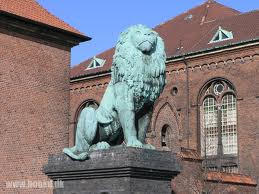 On a sidenote, we talked earlier about the Dutch digraph 'ij' (in printed language). In written language, however, we write a ligature (Unicode: U+0132 IJ, U+0133 ij). Most of the time, the 'ij' is also considered one letter in crosswordpuzzles, and in wordplays the 'ij' is one vowel. Unless i and j don't belong together as in 'bijou', or 'ouija' (which is derived from the French word 'oui' and the German word 'ja' (same as in Dutch: ja), both meaning 'yes' — and it is a trademark). Yes, I remember, and I also noticed that there were two locations near the 26-people-village of Nederland you mentioned you had been to which showed this digraph. It’s another fascinating Dutch feature for me. Your ’written’ link is broken somehow. I cannot see what should be wrong with it looking at it in this quote I’m working with, but I was curious enough to fish what I needed to get to see what it looks like. And, adriverhoef, especially the middle example is pretty. Almost looks like calligraphy. And, yes, we also say ’ja’ if we don’t mean no. It will change into 'jo' if you're asked something with a negation in it 'Don't you think pink is a pretty color?' There the correct answer is 'jo' if you agree. Crossword puzzles!  In Dutch? Mamma mia In Dutch? Mamma mia  Examples: ’bijna’ is pronounced in two ways in the link you state. Is this website trying to collect samples of dialect pronuciations? Do I understand correctly if they refer to a woman’s voice from Nederland (Vrouwelijk uit Nederland)? That Nederlandtje, you mentioned? (Vrouwelijk uit Nederland). Hij is bijna nabij = He is nearly nearby. Hij staat aan de zijlijn = He is standing at the sideline. How to pronounce the 'ij' in a word like 'bij' (= near)? You'd have to put two vowels together, like the 'e' in 'pen' and the 'ee' in 'bee' (insect): e + ee => [ ɛɪ ] bijrijder (driver's mate): [ *b ɛɪ . 'r ɛɪ . d ə r ] Wordplay: "Zie je die vliegen vliegen? Er zit geen bij bij." = Do you see those flies flying? There isn't a bee involved. Really cute. I cannot come with anything remotely near that. But I’ll put it on my already throbbing backburner.My vocabulary still centers around ’ezel’ my anker (Anker in German = anchor = anker in Danish, and as far as I can see in Dutch as well). I plan to make my personal glossary. I have 'ezel', 'beetje' and 'scrupules' so far; well, with some imagination you could almost form a sentence  Oh, we shouldn't forget the music. Only music, no lyrics unless you request them. This is in English, though. Aqua with Barbie Girl - a fairly big hit internationally, I think. |
||
|
|
adriverhoef
Master Cruncher The Netherlands Joined: Apr 3, 2009 Post Count: 2358 Status: Offline Project Badges:
|
Einige Aufklärunge (some explanations) …
wordfeuden = to play the game of Wordfeud (a Scrabble-like app on your smartphone) Is that an Apple thing as well? If it’s Android I better stop asking right here Let's see if I can make the following quote look any better than I did before — I was using the 'url'-tag where it should have been the 'img'-tag … On a sidenote, we talked earlier about the Dutch digraph 'ij' (in printed language). In written language, however, we write a ligature (Unicode: U+0132 IJ, U+0133 ij). (Can't seem to get it to work with 'img'-tags nor with 'url'-tags.  Anyway …) Anyway …)Most of the time, the 'ij' is also considered one letter in crosswordpuzzles, and in wordplays the 'ij' is one vowel. Unless i and j don't belong together as in 'bijou', or 'ouija' (which is derived from the French word 'oui' and the German word 'ja' (same as in Dutch: ja), both meaning 'yes' — and it is a trademark). Yes, I remember, and I also noticed that there were two locations near the 26-people-village of Nederland you mentioned you had been to which showed this digraph.How to pronounce the 'ij' in a word like 'bij' (= near)? You'd have to put two vowels together, like the 'e' in 'pen' and the 'ee' in 'bee' (insect): e + ee => [ ɛɪ ] ’bijna’ is pronounced in two ways in the link you state.bijrijder (driver's mate): [ *b ɛɪ . 'r ɛɪ . d ə r ] I don't hear any dialect. Nice soft (zacht, sanft) female voice there, by the way.Despite what I just said, the text below the speakers is telling us: "Kun je dit beter uitspreken?" (Can you pronounce this in a better way?) "Heb je een ander accent?" (Do you have some other accent?), so there could be a reason if you see more than one speaker's pronunciation there. Do I understand correctly if they refer to a woman’s voice from Nederland (Vrouwelijk uit Nederland)? Yes, you do, 'vrouwelijk' = female.Wordplay. Here is a nice one: "Als jij Steve Miller Band, wie ben ik dan?" (If you hear this as a Dutchman, you'll think: "Als jij Steve Miller bent, wie ben ik dan?" = If you are Steve Miller, then who am I?) |
||
|
|
|