| Index | Recent Threads | Unanswered Threads | Who's Active | Guidelines | Search |
 |
World Community Grid Forums

 Category: Community

 Forum: Chat Room
 Thread: The Daily Danish
 |
| No member browsing this thread |
|
Thread Status: Active Total posts in this thread: 223
|

|
| Author |
|


|
GeraldRube
Master Cruncher United States Joined: Nov 20, 2004 Post Count: 2153 Status: Offline Project Badges: 


|
The Normans were the people who, in the 10th and 11th centuries, gave their name to Normandy, a region in France. They were descended from Norse Vikings from Denmark, Iceland and Norway who, under their leader Rollo, agreed to swear fealty to King Charles III of West Francia.
----------------------------------------A short history of the Norman peoples Common misconception today is that the Normans were "French." Strictly speaking this is not true although it is a widely held belief and, like most beliefs, has some basis in fact. Norman trade and raiding routes - early 10th century ADTowards the end of the ninth century, the Viking raiders from Northern Europe (commonly known as Norsemen) were regularly foraging (raiding and trading) along the coast line of the Frankish kingdoms. During these raids, the Vikings got more and more bold - even going as far as sailing up the Seine and sacking Paris. Initially the raiders would set off from their home villages in Scandinavia and return a few weeks later with any plunder they had gathered, however as the raids continued the Norsemen started establishing raiding bases away from home. It was during this time that England was invaded by the "Grand Army" These bases were often in very good farmland and quickly grew rich with the spoils of war, and as a result of this quickly grew in size. Portchester Castle - Normans Built a Castle inside a Roman Fort placed to defend the shoresIn AD. 911, the Frankish King Charles (the Simple), in an effort to reduce the raids and destruction offered a large amount of land in northern France to a band of Vikings led by Rollo in return for token obedience to the Frankish crown. During the years of "Duke" Rollo's reign, the local term for the "Norsemen" slowly contracted to "Norman" and this pretty much stuck for the rest of time. As befitting the descendants of excellent sea farers, the Normans traded with most of the kingdoms and Empires. They provided soldiers to act as a papal guard and not long after the conquest of the Angle's lands (England) they turned their attention to other places. The Normans raided Italy, and were a driving force behind the Crusades. Nunney castle - Built on French lines by a returning crusaderFrom the British point of view, the main identifiers of the Norman invaders were the language they spoke (a variant of Frankish - French) and their tendency to build castles everywhere. Prior to the Norman occupation, both the Anglo-Saxons and the Celtic Britons before them had lived in smallish communities built on hill tops. These Hill Forts were the primary means of defence and provided a community central point for refuge etc. Portchester Castle - A Norman Castle Inside a Roman FortFollowing the Invasion of AD1066, one of the first things William I wanted to do was to establish Norman control. This was, in part, enforced by the building of Motte and Bailey castles over the land where the Norman Knights could have a base to subjugate the surrounding lands. To ease the building, these were often on the site of Hill Forts, and equally often these hill forts had been removed from the local Celtic/Saxon nobility not to long in the past. Building on hill forts is one of the reasons why so many Norman castles (especially the early ones) are of the famous motte and bailey design. This design is easy to implement over the site of a previous hill fort. On occasion, the Norman buildings were inside even older structures - such as the Norman Castle inside the Roman Fort at Portchester. Luggershall Castle - A Norman Knights Hunting LodgeAnother common trait of the Normans, was their love of Hunting. In addition to the construction of new forest blocks across the Country, the Normans established lots of new laws. These were all very unpopular with the local British - often they were now unable to hunt or farm on their own land. While the Norman hunting may have left some gorgeous forestry blocks, and been responsible for the importation of new species, it certainly was not started from ecological grounds. Another side effect of this hunting fanaticism, was the construction of hundreds of hunting lodges around the country. These mini-castles, like Luggershall were used by the Knights and Kings as places to stay and feast while they were out hunting (which was a lot of the time). Although they were never used as fortified bases in the way the Castles were, the hunting lodges were remarkably well built. A sign of how cheap labour and materials were to the Norman overlords.  |
||
|


|
Former Member
Cruncher Joined: May 22, 2018 Post Count: 0 Status: Offline |
Thank you for keeping this place in working order, GeraldRube
 The Historic Danish I’m not all that familiar with this part of the Danish history, but I know that the Bayeux tapestry depicts Viking longboats. That work of art is so to speak a comic strip about William the Conquerer’s crossing to England and the Battle of Hastings. 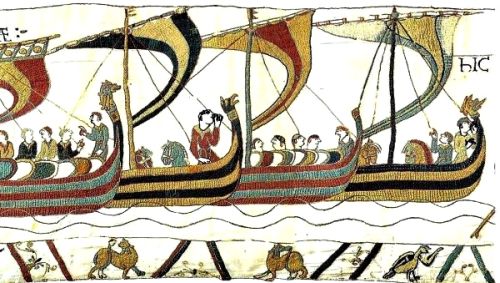 In this website you’ll find a lot of pictures pertaining (and text, but in Danish) to the Norman line of the Vikings. In it it says that the Danish king Harald Blåtand – yes, that is Bluetooth after whom modern day Bluetooth is named - took part in Norman the maneuvres. I would like to see the old man’s face if he could be confronted with that  I have a couple of pictures of the Danish Viking ring fortresses. We have four on present day Danish soil and a fifth is being excavated.  One - and maybe the best preserved - called Trelleborg is about 25 miles/40 km from me. It has a replica of a Viking longhouse and the entire layout can be seen. They not only could sail, they also had a knack for geometry. At the time this fortress/settlement existed, a navigable river lead from the inner Danish waters to the Viking settlement. Aerial photo:  And a rendering of what it may have looked like at the time: |
||
|
|
GeraldRube
Master Cruncher United States Joined: Nov 20, 2004 Post Count: 2153 Status: Offline Project Badges:
|
The Little Mermaid Denmark,
----------------------------------------Den Lille Havfrue. The little Mermaid The Little Mermaid Denmark is the largest tourist attraction and National Symbol. Who don't know The Little Mermaid Denmark? (Danish name- Den Lille Havfrue ), Hans Christian Andersen wrote fairy tale about her in 1837 and later Walt Disney produced the movie. Every year some millions of people visit her and thousand of souvenirs and t-shirts are sold to tourists. It is real National Symbol of Denmark - she is as important for Copenhagen as statue of liberty for New Your and pyramids for Egypt. She is probably the most famous Danish lady. The Litte Mermaid Denmark is wonderful creation of Famous writer Hans Christian Andersen. She is a clear image from our childhood. The Little Mermaid has provided inspiration for many generations. All kids know our bellowed fairy tale about the Little Mermaid who at age of 15 saved the life of shipwrecked prince and fall in love with him. But to become a human the Little Mermaid has to give up her lovely voice. (However ,in most of the folk traditions , mermaids are hostile to all men from surface. Mostly in folklore they lure sailors to deaths. Take for example such significant story like Odyssey. The singing of the sirens is so beautiful that men jump into the sea ). And now you can easily find 92 year old bronze sculpture The little Mermaid sitting at Langelinie ( longest embankment in the city ) Only a 10-minute walk from the cruise ship pier in Copenhagen. But the history of the Little Mermaid wasn't so easy . The idea to construct such monument came to Brewer Carl Jacobsen founder of probably best beer in the world - Carlsberg. He asked sculptor Edvard Eriksen( Naturalistic sculptor . 1876-1959) to create this splendid sculpture. And as the result 23 August 1913 Carl Jacobsen made generous gift to Copenhagen city- bronze sculpture of the Little Mermaid Denmark ( which weighs 175 kg ). Still exist some uncertainties if Ellen Prince ( Sole dancer at the Royal Theatre 1903-1913 ) really modeled for this sculpture. Exist an opinion that Ellen didn't want to pose naked , and Eriksen had to ask his own wife to pose instead of her. But anyway the head is exact reflection of Ellen Prince. The impression from this sculpture is actually controversial. And frankly speaking mostly people find her too SMALL. Because this Great monument is only 1,6 meter high. And she is supposed to disappoint you . Like a millions of other people. But still it is worth to visit the Little Mermaid Denmark because it is really impossible to imagine Copenhagen without it. The Little Mermaid of Denmark survived the Great Depression and the world war 2 , but modern times haven't been so kind to her. She was frequently defaced and vandalized. 28 April 1961 - the hair of the Little Mermaid Denmark was painted with red paint and she was dressed in nice bra 24 April 1963 --she was painted with red paint. In the night 23-24 April 1964 unknown vandal cut off her head . Police couldn't manage to find it . One joker , Danish writer Jorgen Nash told that it was he who has committed this crime . He gave metal box to Danish national museum and told that the head inside. But unfortunately due to Danish law . They can open the box only 50 years after this person will die. And he is still alive . So this is really joke with long beard. 15 July 1976 - she was drenched with same color paint again. 22 July 1984 - her right arm was cut off. Some days later two man return the arm. They told that they had amputated the arm then they were deadly drunk. 5 August 1990 - was discovered the attempt to cut off again the head to lady. 18 cm long cut . 6 January 1998 - the Little Mermaid lost her head for the second time. 11 September 2003 - she was knocked down from her stone . All tourists were shocked then discover haven't found Famous Danish lady at her usual place. For now it is still very acute question . Officials in Denmark is considering moving this famous landmark - the Little Mermaid Denmark sculpture- in order to protect it from tourists and vandals. They are planning to move here several metres offshore. "It is natural way to protect her. We are doing a preliminary inquiry to see what would be required from both an aesthetic and an economic point of view. We should have a clearer picture by this spring or summer" said Jens Peter Munk- Copenhagen's keeper of public monuments. |
||
|
|
Former Member
Cruncher Joined: May 22, 2018 Post Count: 0 Status: Offline |
Thank you for posting this, GeraldRube
---------------------------------------- It's hard to be a mermaid.  This picture is from June 18, 2017, the only beautiful summer day we had that year. I treated myself to a most enjoyable boat trip through the harbor and the canals of Copenhagen. I had a lot of visitors that day  Here is a link to Hans Christian Andersen's fairy tale in English. It is longish and it's very sad  And here are the original illustrations from the first print of the fairy tale: Illustration 1 Illustration 2 Illustration 3 Illustration 4 [Edit 2 times, last edit by Former Member at Feb 24, 2018 9:14:20 AM] |
||
|
|
GeraldRube
Master Cruncher United States Joined: Nov 20, 2004 Post Count: 2153 Status: Offline Project Badges:
|
After Sweden permanently broke away from the personal union, Denmark tried on several occasions to reassert control over its neighbour. King Christian IV attacked Sweden in the 1611–1613 Kalmar War but failed to accomplish his main objective of forcing it to return to the union. The war led to no territorial changes, but Sweden was forced to pay a war indemnity of 1 million silver riksdaler to Denmark, an amount known as the Älvsborg ransom.[34] King Christian used this money to found several towns and fortresses, most notably Glückstadt (founded as a rival to Hamburg) and Christiania. Inspired by the Dutch East India Company, he founded a similar Danish company and planned to claim Ceylon as a colony, but the company only managed to acquire Tranquebar on India's Coromandel Coast. Denmark's large colonial aspirations were limited to a few key trading posts in Africa and India. The empire was sustained by trade with other major powers, and plantations – ultimately a lack of resources led to its stagnation.[35]
----------------------------------------In the Thirty Years' War, Christian tried to become the leader of the Lutheran states in Germany but suffered a crushing defeat at the Battle of Lutter.[36] The result was that the Catholic army under Albrecht von Wallenstein was able to invade, occupy, and pillage Jutland, forcing Denmark to withdraw from the war.[37] Denmark managed to avoid territorial concessions, but King Gustavus Adolphus' intervention in Germany was seen as a sign that the military power of Sweden was on the rise while Denmark's influence in the region was declining. In 1643, Swedish armies invaded Jutland and claimed Scania in 1644. In the Denmark–Norway union, Denmark was the dominant partner, and eventually gained rule over Norway and Norwegian dependencies (Faroe Islands, Iceland and Greenland). In the 1645 Treaty of Brømsebro, Denmark surrendered Halland, Gotland, the last parts of Danish Estonia, and several provinces in Norway. In 1657, King Frederick III declared war on Sweden and marched on Bremen-Verden. This led to a massive Danish defeat and the armies of King Charles X Gustav of Sweden conquered both Jutland, Funen, and much of Zealand before signing the Peace of Roskilde in February 1658, which gave Sweden control of Scania, Blekinge, Trøndelag, and the island of Bornholm. Charles X Gustav quickly regretted not having wrecked Denmark and in August 1658, he began a two-year-long siege of Copenhagen but failed to take the capital.[38] In the following peace settlement, Denmark managed to maintain its independence and regain control of Trøndelag and Bornholm. Denmark tried to regain control of Scania in the Scanian War (1675–1679) but it ended in failure. After the Great Northern War (1700–21), Denmark managed to restore control of the parts of Schleswig and Holstein ruled by the house of Holstein-Gottorp in the 1720 Treaty of Frederiksborg and the 1773 Treaty of Tsarskoye Selo, respectively. Denmark prospered greatly in the last decades of the 18th century due to its neutral status allowing it to trade with both sides in the many contemporary wars. In the Napoleonic Wars, Denmark traded with both France and the United Kingdom and joined the League of Armed Neutrality with Russia, Sweden, and Prussia.[39] The British considered this a hostile act and attacked Copenhagen in 1801 and 1807, in one case carrying off the Danish fleet, in the other, burning large parts of the Danish capital. This led to the so-called Danish-British Gunboat War. British control of the waterways between Denmark and Norway proved disastrous to the union's economy and in 1813 Denmark–Norway went bankrupt. The union was dissolved by the Treaty of Kiel in 1814; the Danish monarchy "irrevocably and forever" renounced claims to the Kingdom of Norway in favour of the Swedish king.[40] Denmark kept the possessions of Iceland (which retained the Danish monarchy until 1944), the Faroe Islands and Greenland, all of which had been governed by Norway for centuries.[41] Apart from the Nordic colonies, Denmark continued to rule over Danish India from 1620 to 1869, the Danish Gold Coast (Ghana) from 1658 to 1850, and the Danish West Indies from 1671 to 1917. |
||
|
|
Former Member
Cruncher Joined: May 22, 2018 Post Count: 0 Status: Offline |
Thank you once again, GeraldRube, for posting in what is currently
The Historic Danish - not much takes place these days so it's a big help you keep this thread alive Oh, tsk, tsk, tsk! What a mess, GeraldRube. But again: We forgive Christian IV everything  On the positive side we can notice, that Norway didn't like to belong to Sweden. In 1905 Norway gained independence, and they chose Danish Prince Carl as their first king and called him Haakon IIV. The relationship between Norway and Denmark is like between a brother and a sister who love each other dearly. As to Sweden, the southern part - roughly the area we lost: Definitely Skåne (you call it Scania, which is also the name of a heavy duty truck) and to a certain degree Halland and Blekinge - have deep leanings to Denmark and often wish they could be Danes. The Scanian people even use a flag which is a cross between the Swedish (blue with a yellow cross) and the Danish (red with a white cross). By the way, the easterly island of Bornholm was occupied for a year by Soviet forces after WW II.  |
||
|
|
GeraldRube
Master Cruncher United States Joined: Nov 20, 2004 Post Count: 2153 Status: Offline Project Badges:
|
During the Middle Ages, the rights of women were regulated by the county laws, the landskabslovene from the 13th-century, and therefore varied somewhat between different counties: however, a married woman was generally under the guardianship of her spouse. Sons and daughters both had right to inheritance, though sisters inherited half of the portion of a brother.
----------------------------------------The cities were regulated by the city laws. With the exception of widows, who inherited the right to the trade of her late spouse, women was not allowed membership in the guilds, which monopolized most professions in the cities: however, in practice, it was very common for women, whether married or not, to be granted dispensation to manage a minor business for the sake of her own support, and become a købekone (business woman), a custom which continued until women were given the same rights as men within commerce in 1857. The Civil Code of 1683, or Christian 5.s Danske Lov (also enacted in the Danish province of Norway as the Civil Code of 1687 or Christian Vs Norske Lov[5] ), defined all unmarried females regardless of age as minors under the guardianship of their closest male relative, and a married woman under the guardianship of her spouse, while only widows were of legal majority. This code was in effect until the 19th-century: in 1857, unmarried women were given legal majority, while married women were given the same right in 1899. Girls were included as pupils in the first attempt of a public elementary school system in 1739, though this attempt was not fully realized until 1814. From the 1780s, schools for secondary education for females were established in the capital of Copenhagen, though female teachers were only allowed to teach girls or very small boys. One of the first schools for females of any note was the Døtreskolen af 1791, and in the 1840s, schools for girls spread outside the capital and a net of secondary education girl schools was established in Denmark. In 1875, women were given access to university education. In the reformed law of access in 1921, women were formally given access to all professions and positions in society with the exception of some military and clerical positions and the position of judge (given in 1936). |
||
|
|
Former Member
Cruncher Joined: May 22, 2018 Post Count: 0 Status: Offline |
Thank you, once again, GeraldRube. Soon you are an expert on Denmark and Danish affairs.
You see, equality between the sexes is in our genes, and as I have previously explained, the women took care of farms and business while the Vikings ploughed the seas in their longboats. Of course, there have be details to finetune, but in general our posititon as women has been fairly good, and in general we women were respected as human beings with brains under our blonde hair. In an earlier post you also described how a woman was buried with the keys - a symbol of status. 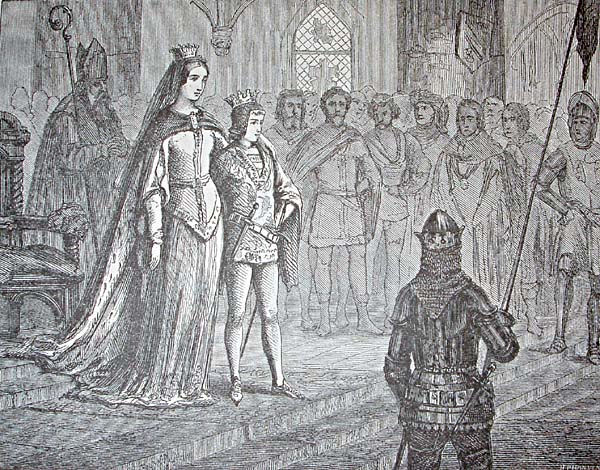 This is Queen Margrethe I (our present is Margrethe II). Margrethe I was the most powerful woman in her time. She made a union out of Norway, Denmark, and Sweden, called Kalmarunionen - the Calmar Union - for the Swedish Castle where it was signed.  |
||
|
|
GeraldRube
Master Cruncher United States Joined: Nov 20, 2004 Post Count: 2153 Status: Offline Project Badges:
|
Nordic Mobile Telephone
----------------------------------------NMT (Nordisk MobilTelefoni or Nordiska MobilTelefoni-gruppen, Nordic Mobile Telephony in English) is the first fully automatic cellular phone system. It was specified by Nordic telecommunications administrations (PTTs) and opened for service on 1 October 1981 as a response to the increasing congestion and heavy requirements of the manual mobile phone networks: ARP (150 MHz) in Finland, MTD (450 MHz) in Sweden and Denmark, and OLT in Norway. The Mobira Cityman 150, Nokia's NMT-900 mobile phone from 1989 (left), compared to the dual-band GSM Nokia 1100 phone from 2003.[1] NMT is based on analog technology (first generation or 1G) and two variants exist: NMT-450 and NMT-900. The numbers indicate the frequency bands used. NMT-900 was introduced in 1986 and carries more channels than the older NMT-450 network. The NMT specifications were free and open, allowing many companies to produce NMT hardware and pushing prices down. The success of NMT was important to Nokia (then Mobira) and Ericsson. First Danish implementers were Storno (then owned by General Electric, later taken over by Motorola) and AP (later taken over by Philips). Initial NMT phones were designed to mount in the trunk of a car, with a keyboard/display unit at the driver's seat. "Portable" versions existed, though they were still bulky, and with battery life still being a big problem. Later models such as Benefon's were as small as 100 mm (3.9 inches) and weighed only about 100 grams. History The NMT network was opened in Sweden and Norway in 1981, and in Denmark and Finland in 1982. Iceland joined in 1986. However, the first commercial service was introduced in Saudi Arabia on 1 September 1981 to 1,200 users, one month before Sweden. By 1985 the network had grown to 110,000 subscribers in Scandinavia and Finland, 63,300 in Norway alone, which made it the world's largest mobile network at the time. The NMT network has mainly been used in the Nordic countries, Baltic countries, Switzerland, Netherlands, Hungary, Poland, Bulgaria, Romania, Czech Republic, Slovakia, Slovenia, Serbia, Turkey, Croatia, Bosnia, Russia, Ukraine and in Asia. The introduction of digital mobile networks such as GSM has reduced the popularity of NMT and the Nordic countries have suspended their NMT networks. In Estonia NMT network was shut down in December 2000. In Finland TeliaSonera's NMT network was suspended on 31 December 2002. Norway's last NMT network was suspended on 31 December 2004. Sweden's TeliaSonera NMT network was suspended on 31 December 2007. The NMT network (450 MHz) however has one big advantage over GSM which is the range; this advantage is valuable in big but sparsely populated countries such as Iceland. In Iceland, the GSM network reaches 98% of the country's population but only a small proportion of its land area. The NMT system however reaches most of the country and a lot of the surrounding waters, thus the network was popular with fishermen and those traveling in the interior. In Iceland NMT service was stopped on 1 September 2010, when Síminn closed down its NMT network. In Denmark, Norway and Sweden the NMT-450 frequencies has been auctioned off to Swedish Nordisk Mobiltelefon which later became Ice.net and renamed to Net 1 that built a digital network using CDMA 450. During 2015, the network has been migrated to 4G. The permission for TeliaSonera to continue operation of NMT-450 ended on 31 December 2007. In Russia Uralwestcom shut down their NMT network on 1 September 2006 and Sibirtelecom on 10 January 2008. Skylink, subsidiary company of TELE2 Russia operates NMT-450 network as of 2016 in Arkhangelsk region and Perm region. These networks are used in sparsely populated areas with long distance. License for the provision of services is valid until 2021 Technology The cell sizes in an NMT network range from 2 km to 30 km. With smaller ranges the network can service more simultaneous callers; for example in a city the range can be kept short for better service. NMT used full duplex transmission, allowing for simultaneous receiving and transmission of voice. Car phone versions of NMT used transmission power of up to 15 watt (NMT-450) and 6 watt (NMT-900), handsets up to 1 watt. NMT had automatic switching (dialing) and handover of the call built into the standard from the beginning, which was not the case with most preceding car phone services, such as the Finnish ARP. Additionally, the NMT standard specified billing as well as national and international roaming. Signaling NMT voice channel is transmitted with FM-modulation[6] and NMT signaling transfer speeds vary between 600 and 1,200 bits per second, using FFSK (Fast Frequency Shift Keying) modulation. Signaling between the base station and the mobile station was implemented using the same RF channel that was used for audio, and using the 1,200 bit/s FFSK modem. This caused the periodic short noise bursts, e.g. during handover, that were uniquely characteristic to NMT sound. Security A disadvantage of the original NMT specification is that voice traffic was not encrypted, therefore it was possible to listen to calls using e.g. a scanner. As a result, some scanners have had the NMT bands blocked so they could not be accessed. Later versions of the NMT specifications defined optional analog scrambling which was based on two-band audio frequency inversion. If both the base station and the mobile station supported scrambling, they could agree upon using it when initiating a phone call. Also, if two users had mobile (phone) stations supporting scrambling, they could turn it on during conversation even if the base stations didn't support it. In this case, audio would be scrambled all the way between the 2 mobile stations. While the scrambling method was not at all as strong as encryption of current digital phones, such as GSM or CDMA, it did prevent casual listening with scanners. Scrambling is defined in NMT Doc 450-1: System Description (1999-03-23) and NMT Doc 450-3 and 900-3: Technical Specification for the Mobile Station (1995-10-04)'s Annex 26 v.1.1: Mobile Station with Speech Scrambling – Split Inversion Method (Optional) (1998-01-27). Data transfer NMT also supported a simple but robust integrated data transfer mode called DMS (Data and Messaging Service) or NMT-Text, which used the network's signaling channel for data transfer. Using DMS, also text messaging was possible between two NMT handsets before SMS service started in GSM, but this feature was never commercially available except in Russian, Polish and Bulgarian NMT networks. Another data transfer method was called NMT Mobidigi with transfer speeds of 380 bits per second. It required external equipment. |
||
|
|
Former Member
Cruncher Joined: May 22, 2018 Post Count: 0 Status: Offline |
I tried to look up the first ’automobile telephone’ we had.
I couldn’t find the right type, but it looked like a normal dial-up phone and were it not because my-at-that-time-husband had the unusual choice of transportation (sorry to disappoint you, GeraldRube, but that may be the real reason … the Ford) a Ford Ranchero (he could have chosen that El Camino), there would not have been room for himself. It cost a fortune, and phone conversations were placed via the Post- and Telegraph national broadcast service with live telephone operators. We received little slips indicating price and duration of each call monthly. It was expensive, too, but very reliable. http://www.stornotime.dk/images/cw.jpg http://www.stornotime.dk/sider/forside.htm Our 4G system today covers miserably. If I take a walk in a forest or remote are, I have no coverage at all. I have been to Kenya where it worked everywhere! Even the the wildebeests and lions could connect if they wanted to. I did have a story planned: The Daily Danish Too many Danes still smoke Smoking is one of the most serious health threats to the Danes. Nevertheless some 22% of the population keeps smoking. New studies of the Danes’ smoking habits show that the share of smokers has not fallen since 2011, which the major health organizations is a huge problem as smoking is responsible for one quarter og all deaths in Denmark. Even as many smokers stop the number of smokers has not changed because of new smokers, and the new smokers are primarily children and young people below 18. The stagnation in the share of smokers has lasted for six years after several decades of constant fall, and there is no difference between male and female smokers. Studies show that no less than 72% of present and past smokers would not smoke, could they do their lives over. Therefore it’s important that those who want to stop get an offer of help, because the chance of success is up to five times bigger if there is support. Free support is offered by municipalities from Stoplinien (the Stopline) – Danish, http://stoplinien.dk/ and from smoke cessession apps like E-kvit https://ekvit.dk/ - Danish and Xhale http://xhale.dk/system/english/ - English |
||
|
|
|