| Index | Recent Threads | Unanswered Threads | Who's Active | Guidelines | Search |
 |
World Community Grid Forums

 Category: Community

 Forum: Chat Room
 Thread: A 4 page crash course in epigenetics
 |
| No member browsing this thread |
|
Thread Status: Active Total posts in this thread: 2
|

|
| Author |
|


|
twilyth
Master Cruncher US Joined: Mar 30, 2007 Post Count: 2130 Status: Offline Project Badges: 


|
Since so much of what we do here is related to molecular biology, I thought this would be of interest.
----------------------------------------Epigenetics, as you may know, is the study of how genetic traits are silenced, amplified or otherwise modified in ways that do not involve direct changes to our genetic code. For example, certain coding sequences can be tagged with a marker that prevents that sequence from being transcribed. This generally happens in response to environmental conditions such as a mother not being sufficiently nurturing to her pups. It turns out that these epigenetic changes can last for generations and in some cases may even be permanent. Here is one example from the article that is a little technical but extremely interesting because it raises the possibility of Lamarckian-type inheritance - something that was considered pure heresy for many generations in the field of genetic research. 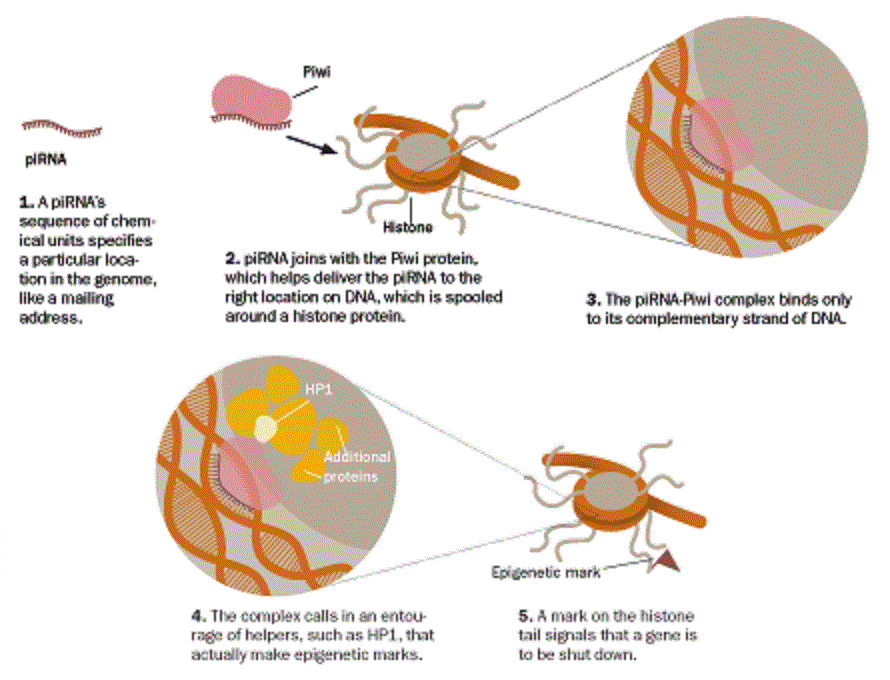 The image is resized since the original was too small. Neither Skinner nor anyone else can yet explain exactly how epigenetic information gets passed to the next generation. But new clues are emerging from studies of worms and flies, and they point to a role for DNA's chemical cousin, RNA. One of RNA's jobs may be to establish where and how densely epigenetic tags are placed. Geneticist Erik Miska and colleagues stumbled onto RNA's secret occupation while investigating an antiviral defense system in tiny, transparent worms called C. elegans. When viral genetic material infects a worm cell, an army of small bits of RNA attacks and neutralizes the threat. About 60 to 80 percent of offspring in each subsequent worm generation "remember" to shut off the viral genes or retain immunity to viruses. Miska's team traced this memory to small RNAs called piRNAs (pronounced "pie RNAs") found in germ cells. When piRNAs trigger the shutdown of a gene, it's permanent, the researchers reported last July in Cell. "It is 100 percent efficient in all the offspring and it continues to act forever, which is very weird," says Miska, of the University of Cambridge in England. Forever, in this case, is at least 30 generations, as far out as his team looked. Scientists are uncovering molecular details about how piRNAs put genes on lock-down. Because RNA is genetic material, it can match up to specific sequences of DNA letters. A cell may contain hundreds of thousands of piRNAs, each with a unique combination of 24 to 32 RNA units, or nucleotides, says Haifan Lin, a stem cell biologist at Yale University. The piRNA's sequence is like an address on a letter specifying where a protein called Piwi should recruit proteins that make epigenetic modifications, Lin and colleagues reported in the March 11 Developmental Cell. In the fruit flies Lin studies, as in worms, the modifier proteins stick methyl groups onto histones. But Lin thinks piRNAs may similarly direct DNA methylation enzymes in mammals, including humans.   |
||
|


|
Sgt.Joe
Ace Cruncher USA Joined: Jul 4, 2006 Post Count: 7849 Status: Offline Project Badges:


|
Interesting.
----------------------------------------
Sgt. Joe
*Minnesota Crunchers* |
||
|
|
|